
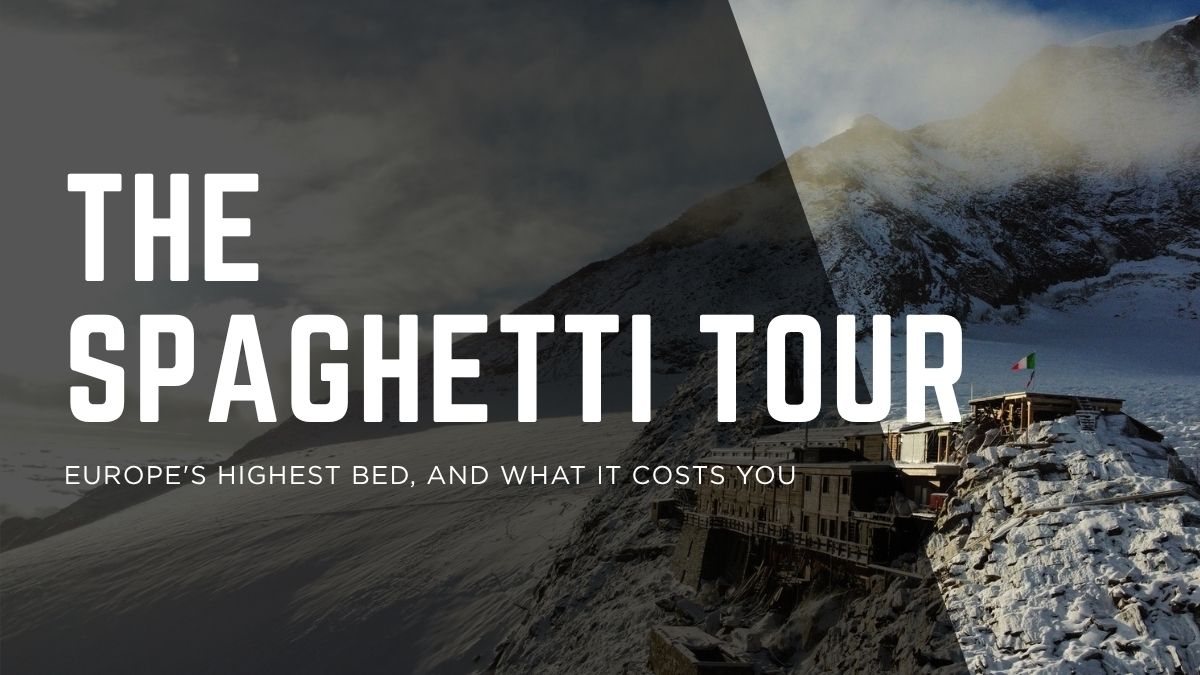
There is a building on the summit of a 4,554m peak on the Italian Swiss border. It sleeps seventy people. It has a bar, hot food, mains electricity, a library, and a laboratory where researchers study what thin air does to the human body.
It is the highest building in Europe. And you can book a bed in it.
The best known way to get there is a route called the Spaghetti Tour, and it is one of the strangest propositions in the Alps: a multi day mountaineering traverse that collects more 4,000m summits than most climbers tick in a decade, feeds you pasta and espresso every night, and hands you a sleeping altitude that Himalayan trekkers spend a week walking up to.
That last part is the whole story, and it gets buried under the food jokes.
What the Spaghetti Tour actually is
The Spaghetti Tour is a hut to hut high altitude traverse of the Monte Rosa massif, which straddles the border between Switzerland’s Valais and Italy’s Piedmont and Aosta valleys. Monte Rosa is the second highest massif in the Alps after Mont Blanc, and it is packed with 4,000m summits sitting close enough together to be linked in a chain.
That is the trick of the route. You go up once and stay up. Instead of climbing a peak, descending to the valley, driving somewhere else and starting again, you gain altitude on day one and then move across the top of the massif for days, sleeping in Italian refuges the whole way, never dropping below about 3,000m until the end.
Most itineraries start from Zermatt on the Swiss side, using the Klein Matterhorn lift to gain the glacier, or from Alagna and Gressoney on the Italian side, where the lifts run up to Punta Indren at 3,275m. The centrepiece is a night at the Margherita Hut on the summit of Signalkuppe, also called Punta Gnifetti, at 4,554m.
The terrain is glacier travel and ridge work. Roped up, crampons on, ice axe in hand, with exposure on some of the connecting ridges that will get your full attention. It is not technically hard by alpine standards. There is no serious climbing on the standard line. What it is, relentlessly, is high.
Why it is called that
Because the huts are Italian.
The route runs mostly on the Italian side of the border, and Italian refuges take their kitchens seriously. Climbers come off a glacier at 3,600m and sit down to pasta. The Margherita Hut has been known to serve pizza at 4,554m. Somewhere along the way the name stuck, and now a serious mountaineering traverse is known worldwide by a joke about dinner.
The Margherita Hut itself deserves the reputation. It was inaugurated in 1893 and named for Queen Margherita of Savoy, who climbed up and slept there that same year. It is owned by the Varallo section of the Italian Alpine Club, is staffed from roughly mid June to mid September, and is anchored to the summit rock with steel cables because of what the wind does up there.
The peak count nobody agrees on
Here is the first thing to know before you book anything.
“The Spaghetti Tour” is not one fixed route. Search it and you will find operators selling four peaks in four days, ten peaks in five or six days, and a full linkup touching eighteen. The peaks that come up most often are the Breithorn at 4,164m, Pollux at 4,092m, Castor a shade over 4,200m, the Vincent Pyramid, Balmenhorn, Corno Nero, Ludwigshöhe at 4,341m, Parrotspitze at 4,432m, Signalkuppe at 4,554m and Zumsteinspitze just above it. The biggest versions add the Lyskamms, the Nordend at 4,608m, and Dufourspitze at 4,634m, the highest point in Switzerland.
Some of those “summits” are small bumps on a ridge you walk over on the way to something else. Others are proper mountains that would be the highlight of anyone’s season on their own. Both count as ticks, which is how one climber’s five day tour produces four summits and another’s produces eighteen.
None of that is dishonest. It just means the phrase tells you almost nothing. Two people can say they did the Spaghetti Tour and have done meaningfully different trips. Read the day by day itinerary, not the headline number.
The part that actually decides your trip
Now the altitude.
Look at how fast you get high on this route. From Alagna in the valley, the lift system puts you at 3,275m, and about two hours of walking from there puts you in Rifugio Gnifetti at 3,647m. That is a valley floor breakfast and a bed above 3,600m the same night. Two days later you can be sleeping at 4,554m.
Compare that with the trek everyone uses as their altitude benchmark. A standard Everest Base Camp itinerary takes something like a week to get you sleeping at 4,410m in Dingboche, and it builds in two dedicated acclimatization days to do it. That itinerary exists in that shape for a reason. It is slow on purpose.
The Spaghetti Tour gets you to 4,554m in a fraction of that time, and it does it because a cable car does most of the early work. Nothing about the route punishes you for arriving unacclimatized. It simply assumes you did the acclimatizing somewhere else, beforehand, on your own initiative.

There is an irony sitting on top of all this. The Margherita Hut has hosted high altitude physiology research since the late 1800s and still houses a laboratory today. Scientists go up there specifically because sleeping at 4,554m is a reliable way to make a human body show what hypoxia does to it. Climbers pay to sleep in the same building and are sometimes surprised when the bed does exactly what the lab is there to measure.
This is awareness only and not medical advice. What it means practically is that acclimatization is a planning decision you make weeks out, not a thing the itinerary does for you. Good operators build in a preparatory night, keep the pace deliberately slow, and are ready to turn people around. Ask any guide you are considering how they handle acclimatization before you ask about the summits, and if the answer is thin, that tells you what you need to know.
What it asks of your body
Three things, in order of how often they get underestimated.
Repeatability at altitude. No single day on this route is monstrous. Four to eight hours of glacier travel, a few hundred metres of gain, done in time to get off the snow before the afternoon. The test is doing that again the next morning, and again the morning after that, on broken hut sleep, at an altitude where recovery is worse than anything you have trained in. This is the same demand a long hut to hut trek makes, with the oxygen turned down.
Legs that work on the way down. Every one of those summits gets descended, on snow, in crampons, roped, often on softening afternoon snow that grabs at your feet. Downhill loading is where trip ending damage tends to accumulate, and it is the part almost nobody deliberately trains. We have written about that at length in The Descent Is What Breaks You, and it applies here with an extra layer, because a tired mistake on a crevassed glacier is not the same as a tired mistake on a trail.
An aerobic engine with margin. At 4,500m your usable output drops hard. Whatever pace feels sustainable at home, plan on a fraction of it. The climbers who enjoy this route are the ones whose easy pace is genuinely easy, because that is the only pace available up there.
Grip, upper body and core matter on the exposed ridge sections and for self arrest technique, but they are not the limiter. Legs and lungs are.
Who it is actually for
Operators disagree, openly, and it is worth knowing where they land.
Some sell the shorter Italian side versions as a first glacier experience, with a day of instruction on roping up, crampon work and crevasse rescue basics before you go anywhere. Others state flatly that you need a previous 4,000m summit, Mont Blanc or equivalent, before they will take you.
Both positions are defensible, because they are describing different trips. A four day version topping out at the Margherita Hut with a guide teaching you as you go is a genuine introduction to glaciated mountaineering. A six day linkup taking in the Lyskamms and Dufourspitze is a serious alpine week that will expose any gap in your fitness or your head for exposure.
The honest test is not “can I get up a mountain.” It is “can I move safely on a rope team, on ice, on my fourth consecutive day, above 4,000m, when I am tired and the snow is bad.” If the answer is not obviously yes, go with the shorter version and a low guiding ratio, and come back for the long one.
For trekkers eyeing the step up, this is one of the more logical doorways in Europe. You are not learning to climb. You are learning to travel on glaciers, at altitude, for consecutive days, which is exactly the skill set that separates the trekking world from the mountaineering one.
Training for it
Everything above points the same direction. Build an aerobic base that repeats rather than one that peaks. Load your legs for descent, not just ascent. Carry a pack in training, because you will carry one up there. And accumulate long days back to back, so that day four is a known quantity instead of a discovery.
That work is trainable at sea level, months before you ever see a glacier. The altitude is the part you cannot train at home, which is exactly why the fitness underneath it has to be finished before you arrive.
Our Trekking Fitness Plan builds that base: the aerobic engine, the leg durability, and the consecutive day capacity that any hut to hut route demands. Our 10 Week Mountaineering Fitness Plan is aimed at the rung above, where the days end on glaciated ground with a rope on.
The Spaghetti Tour sits right on the line between those two worlds. That is what makes it worth doing, and what makes it worth respecting.
